Editing Text for Website
The IPSOS app is an online platform where anyone can sonify data taken from the Large Hadron Collider!
The IPSOS app was developed as part of the Dark Matter project, a collaboration between CERN and the laptop group, the Birmingham Ensemble for Electroacoustic Research. The idea of this project was to develop ways of transforming data from experiments at the Large Hadron into electronic music and visuals, allowing us to hear and see the results of this cutting-edge research into the nature of the universe.
Here you can explore and play! The website also holds information on physics, dark matter, sonification and sound synthesis, if you would like to discover more about the theory behind the app.
The Dark Matter project is a collaboration between: CERN BEER art@CMS Maurizio Pierini (physicist) Kostas Nikolopoulos (physicist) Tom McCauley (physicist)
Particle physics (which also known as high energy physics) is a branch of physics that
studies the nature of the particles that constitute(/form) matter and radiation. Particle
physics normally investigates the smallest detectable particles and the fundamental
interactions necessary to explain their behaviour.
-
A particle
An extremely small piece of matter.
-
An atom
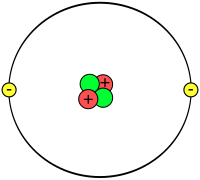
Atoms have a tiny but dense, positive nucleus and a cloud of negative electrons (e-). The nucleus consists of protons (p+), which are positively charged, and neutrons (n), which have no charge.
Protons and neutrons are composed of even smaller particles called quarks. The electrons are in constant motion around the nucleus, protons and neutrons move within the nucleus, and quarks wiggle within the protons and neutrons.
The Standard Model
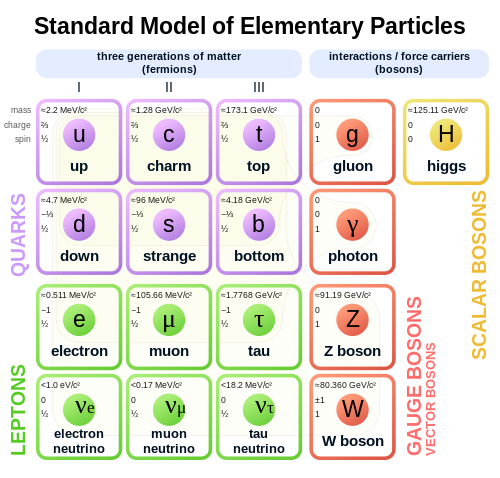
The theory called The Standard Model explains what the world is and what holds it together. It is a simple and comprehensive theory that explains all the hundreds of particles and complex interactions with only:
- 6 quarks.
- 6 leptons (- the best-known lepton is the electron!)
- Force carrier particles (e.g. a photon)
All the known matter particles are composites of quarks and leptons, and they interact by exchanging force carrier particles.
Matter
The whole world is made up of quarks and leptons.
Quarks behave differently than leptons, and for each kind of matter particle there is a corresponding antimatter particle.
Quarks
Quarks only exist in groups with other quarks and are never found alone. Composite particles made of quarks are called Hadrons. Although individual quarks have fractional electrical charges, when they combine a net integer electric charge is produced.
Leptons
The best-known lepton is the electron (e-). The other two charged leptons are the muon(μ) and the tau(τ), which are charged like electrons but have a lot more mass. The other leptons are the three types of neutrinos (ν). They have no electrical charge, very little mass, and they are very hard to find.
For every type of matter particle we've found, there also exists a corresponding antimatter particle, or antiparticle. Antiparticles look and behave just like their corresponding matter particles, except they have opposite charges. E.g. a proton is electrically positive whereas an antiproton is electrically negative. When a matter particle and antimatter particle meet, they annihilate into pure ENERGY.

The majority of the universe may not be made of the same type of matter as the Earth. Roughly 80 percent of the mass of the universe is made up of material that scientists cannot directly observe. This is known as dark matter. Unlike normal matter, dark matter does not interact with electromagnetic force (-a type of physical interaction that occurs between electrically charged particles e.g. electromagnetic Waves, radio waves, light waves, thermal radiation, X- ray etc.)
This means that dark matter does not absorb, reflect or emit light, making it extremely hard to spot. In fact, researchers have been able to infer the existence of dark matter only from the gravitational effect it seems to have on visible matter. It only interacts with normal matter through gravity and possibly another, very weak type of interaction. There is strong evidence that it might not be made up of protons, neutrons, and electrons.
Dark matter seems to outweigh visible matter roughly six to one, making up about 27% of the universe.
Dark matter, in other words, is not merely the stuff of black holes and deep space. It is all around us! What is dark matter?


The equation E = mc2, by physicist Albert Einstein is a theory of special relativity that expresses the fact that mass and energy are the same physical entity and can be changed into each other. Mass is simply a form of energy.
When a physicist wants to use particles with low mass to produce particles with greater mass, they put the low-mass particles into an accelerator, give them a lot of kinetic energy (speed), and then collide them together. During this collision, the particle's kinetic energy is converted into the formation of new massive particles. It is through this process that we can create massive unstable particles and study their properties.
A good analogy of how physicists study particles through colliding is the car crash example. Imagine a person wanted to look inside cars. By crashing two cars together at very high speeds, we can break the cars apart and see inside. In the same way, physicists crash two particles together in order to break them and study the inside.
Car example.

The Accelerator
As all particles behave like waves, physicists use accelerators to increase a particle's momentum, thus decreasing its wavelength enough that physicists can use it to poke inside atoms. Second, the energy of speedy charged particles (creating a large electric field) is used to create the massive particles that physicists want to study.
Through speeding up the particles, the particles bas into a target or other particles. Surround the collision points are detectors that record the many pieces of the event.
“This is called high-energy physics, due to the large amount of energy needed. An example of a "natural" particle accelerators is a supernovae explosion, which collides with other particles in our atmosphere.”
The Event
After an accelerator has pumped enough energy into its particles, they collide either with a target or each other. Each of these collisions is called an event. The physicist's goal is to isolate each event, collect data from it, and check whether the particle processes of that event agree with the theory they are testing.
Each event is very complicated since lots of particles are produced. Most of these particles have lifetimes so short that they go an extremely short distance before decaying into other particles, and therefore leave no detectable tracks.
Detectors
Modern physicists must look at particles' decay products, and from these deduce the particles' existence. To look for these various particles and decay products, physicists have designed multi-component detectors that test different aspects of an event. Each component of a modern detector is used for measuring particle energies and momenta, and/or distinguishing different particle types. When all these components work together to detect an event, individual particles can be singled out from the multitudes for analysis. Following each event, computers collect and interpret the vast quantity of data from the detectors and present the extrapolated results to the physicist.

The most powerful accelerator ever built is the Large Hadron Collider (LHC) at CERN in Geneva, accelerating protons and colliding them with a total energy of 13 TeV.
It accelerates protons to nearly the velocity of light -- in clockwise and anti-clockwise directions -- and then collides them at four locations around its ring. At these points, the energy of the particle collisions gets transformed into mass, spraying particles in all directions.
A few facts about the Large Hadron Collider:
- Located 174 metres underground.
- 27 kilometres in circumference - so big it runs underneath the France-Swiss border, near Geneva
- Filled with 2000 giant electromagnets that are at 1.9 Kelvin. That's colder than the space between the stars!
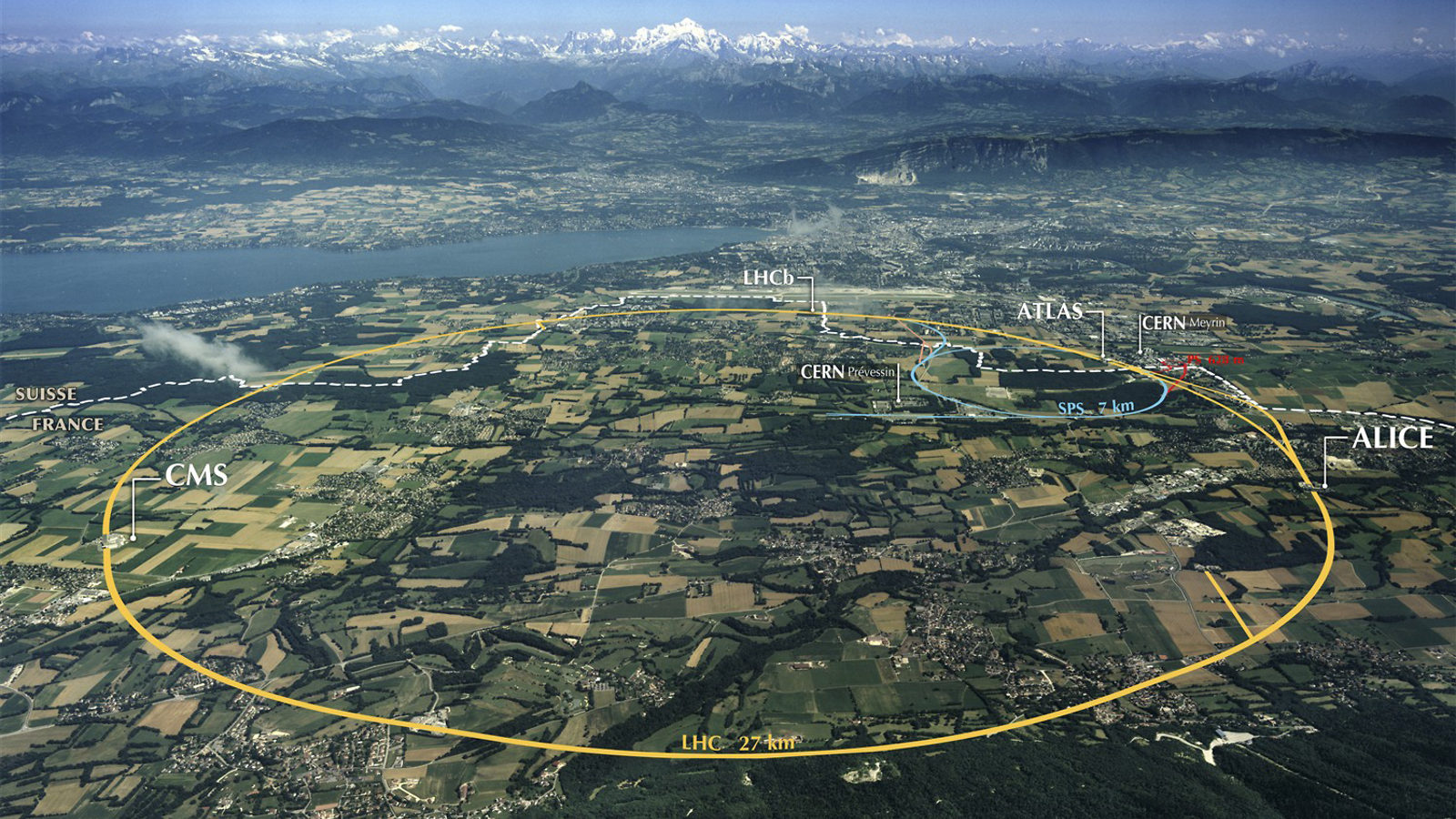

An advantage of laboratory particle accelerators such as the Large Hadron Collider is that there we know the initial conditions of the collisions – namely the type and energy of the particles being collided. We can also create a large (and known) number of collisions and observe them in a controlled environment. These are essential features for detecting dark matter particles!
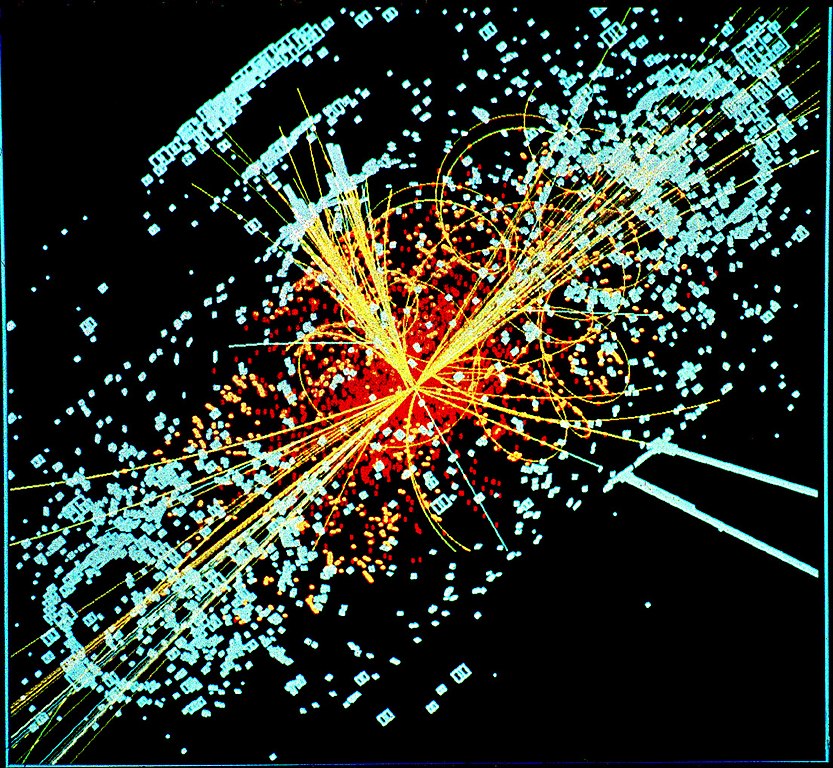
The LHC accelerates protons to nearly the velocity of light, in clockwise and anti-clockwise directions, and then collides them at four locations around its ring. At these points, the energy of the particle collisions gets transformed into mass, spraying particles in all directions.
However, many particles do not simply break apart, such as electrons. As it does not break apart this means the electronic is a fundamental particle. If you were to smash two super-fast electrons against each other, they would not break, but instead they might create more particles around them without breaking (this is another form of decay, known as a hadron jet (-jets of particles)). Visible particles from the Standard Model, include photons, quarks or gluons (forming "jets" of particles), or electrons, muons or tau leptons. The Standard Model says that there are 17 types of fundamental particles, but there are actually twice as many because they can all be created out of antimatter.
Before each collision, the protons travel along the direction of the LHC beams, and not in directions perpendicular to the beams. This means that their momenta in these perpendicular directions – their "transverse momentum" – is zero. A fundamental principle of physics is that momentum is conserved (constant) and so, after the collision, the sum of the transverse momenta of the products of the collision should still be zero. Therefore, if we add up the transverse momenta of all the visible particles produced in the collision and find it not to be zero, then this could be because we have missed the momentum carried away by invisible particles.
Detectors are often made up of multiple layers and devices to measure these different aspects of the particles they study and to figure out the identity of the particles they detect.
Detectors can measure the particle energy and other attributes such as momentum, spin, energy, electrical charge, direction, speed, particle type, in addition to merely registering the presence of the particle. Hadron colliders measure particle momentums in terms of azimuthal angle, transverse momentum, and pseudorapidity.
Breakdown:
Jet = A jet is a narrow cone of hadrons and other particles produced by the hadronisation of a quark or gluon
Constituents = The different components of the particle
M = Mass
Phi = (azimuthal angle) measurement of the azimuth angle (or angle from the x-axis)
Eta = (pseudorapidity) the angle of a particle in relation the particle beam
Pt = (Transverse momentum), the momentum perpendicular to the path of the colliding particles
Charge?

Sound synthesis is the technique of generating sound, using electronic hardware or software, from scratch. The most common use of synthesis is musical, where electronic instruments called synthesizers are used in the performance and recording of music.
Sound is the perceived vibration (oscillation) of air resulting from the vibration of a sound source. We can describe such regular (periodic) vibration in terms of the sum of simpler vibrations (harmonics). Periodic oscillation and hence resulting waveform can be described in terms of the sum of its harmonics. Each harmonic being a simple sine wave (often called a pure tone) with its own respective frequency and amplitude.
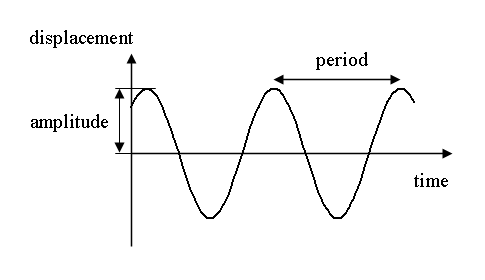
This oscillator creates sound through looping this waveform at a particular frequency. The shape of its waveform can change the sound produced which furthermore changes the timbre of the sound:
1. Sine Wave

[sound example]
2. Square Wave

[sound example]
3. Triangle Wave

[sound example]
4. Sawtooth Wave

[sound example]
An envelope describes how a sound changes over time. Using an ASDR envelope we can control and tailor the sound of the synthesizer as we prefer using the parameters below:
-
Attack is the time taken for initial run-up of level from nil to peak, beginning when the key is pressed.
-
Decay is the time taken for the subsequent run down from the attack level to the designated sustain level.
-
Sustain is the level during the main sequence of the sound's duration, until the key is released.
-
Release is the time taken for the level to decay from the sustain level to zero after the key is released.
While, attack, decay, and release refer to time, sustain refers to level.

Other parameters included in IPSOS:
-
Detune: This describes the effect heard when tuning one oscillator sharp or flat in respect to a second oscillator. This produces a fattening of the sound or it may produce a harmony effect if the interval of the tuning is wide enough.
-
Midinote: Musical pitch (how low or high). Pitch of the pressed key with a value between 0 and 127.
-
Duration: Amount of time a sound will play for
-
Chord: (Jets?? )sounding simultaneously
-
Sequence: (Jets??) sounding separately
3 Examples:
1. Short, attack sound
2. Long, sustained, low sound
3. Sequence sound
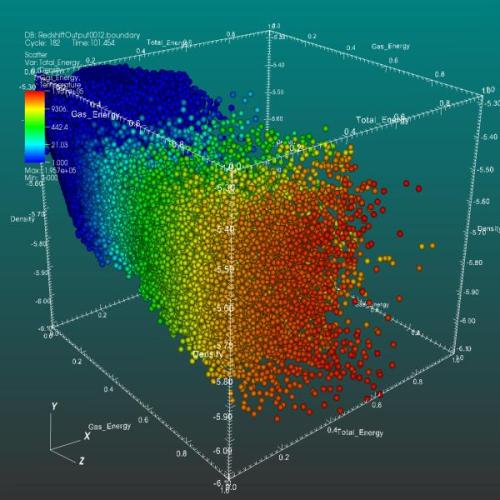
Like the one in the above image, data visualization displays, communicate information (the data) through visual means, e.g. charts, graphs, diagrams, etc. An auditory display is any display that uses sound instead of images (dots, lines, shapes, etc.) to demonstrate the data. Sonification is the transformation of data of any kind (numbers, images, text) into non-speech audio, to represent information.
Human beings naturally have the superior capability to recognize changes and patterns in the different properties of sound through time, such as pitch (frequency), loudness, timbre, texture, etc. This is called Auditory Perception. Sonification, takes advantage of this ability and translates data relationships into changes in sound properties so that they could be understood by the listener.
A very simple example of sonification is a doorbell! The information, which is the fact that someone is at the door, is being transformed into a distinctive sound so that whenever we hear it, we can immediately interpret and understand it.
Below is another simple example of sonification. Listen to how the pitch of the sound changes according to the position of the y variable as we move along the x axis on the parabola graph.

[sound example]

Sonification is a very useful and also common process in our daily lives. From the simplest of functions such as tapping on a watermelon in order to find out whether it is ripe or sweet, to alert sounds produced by different technologies and devices such as alarms, phones, computers, cars, etc. to analysing changes and patterns in complex data, we use and rely on sonification in a wide variety of jobs and tasks.

-
Alarms, alerts, and warnings
Alerts and notifications are sounds used to indicate that something has occurred, or is about to occur, or that the listener should immediately attend to something in the environment. Alerts and notifications tend to be simple and particularly overt. For instance, the beeping sound of the microwave is a sonification which indicates that the cooking time has finished.
-
Status, process, and monitoring messages
There are situations in which the human listener needs to constantly be aware of the current or ongoing state of a system or process. For example, surgeons needs to be aware of the heart-rate of patients at all times during surgery, and therefore use heart-monitoring systems which in addition to visualizations, use sonification to represent heart beats.
-
Data exploration
This is what is generally meant by the term “sonification”, and the intention is to convey information about an entire data set or relevant aspects of the data set. Sonifications for data exploration differ from status or process indicators in that they use sound to show how the values in the data are connected to one-another rather than giving information about a momentary state such as with alerts and process indicators.
-
Art, entertainment, sports, and exercise
Notable among their different applications, sonification and auditory displays have been used to enable the visually-impaired children and adults to take part in team sports, or as a means of bringing some of the experience and excitement of dynamic exhibits to the visually impaired.
In addition, sonifications of events and datasets can be used as the basis for musical compositions, installations and sound-art works. While the designers and/or composers often attempt to convey something to the listener through these sonifications, it is not for the pure purpose of information delivery.

-
Auditory icons and Earcons
-
Auditory icons, are short communicative sounds that have an analogical relationship with the process or action they represent. In other words, it is as if the sound that you hear actually sounds like what it is meant to represent. For example emptying the trash folder on your computer making the sound of crumpling up paper.
[sound example]
-
Earcons, on the other hand, use sounds only as symbols for actions or processes; so the sounds do not necessarily sound like the actions or processes. For instance, the simple beeping of your phone when you receive a text message.
[sound example]
-
-
Audification is the most primary method of direct sonification, whereby waveforms are directly translated into sound. For example, seismic waves, travelling through the Earth’s crust as a result of the vibrations of the tectonic plates over an extended period of time, have been audified so that we can hear actual earthquakes! This approach may require that the waveforms be frequency- or time-shifted [sped up or slowed down] into the range of waveforms which humans can hear.
-
Model-based sonification is a more complex technique of sonification whereby using computer simulations, a virtual model of the data is built which produces sounds according to the relationships within the data, as the user interacts with it. A model, then, is like an instrument that the user ‘plays’ and their interaction drives the sonification.
-
Parameter mapping sonification
Parameter mapping represents changes in some dimension of the data with changes in an acoustic dimension (of sound) to produce a sonification. As we have already learned, synthesized sound, has a multitude of changeable dimensions or parameters such as waveform, pitch, duration, ADSR envelope parameters, etc.
What is a ‘mapping’?
Mapping or data-mapping is the process of creating direct/indirect relationships between two distinct datasets, whereby a change in one dataset would cause a relative change in the other.
Remember the earlier example of the sonification of the parabola graph? This is a parameter mapping sonification since the position parameter of y is directly mapped to the pitch of the sound. We can create a different mapping for the same parabola graph, this time to loudness (amplitude) of the sound, instead of its pitch.
[sound example]

Take for example, the sound produced from the state change of water in a whistling tea kettle as it approaches boiling point. With the rise of the water temperature, the frequency (pitch) of the whistling sound also increases until it reaches a point where the user knows it is time to turn off the stove and pour the boiling water into the teacup. Here, we have a simple one-to-one mapping between one parameter, which is the water temperature, and another which is sound frequency/pitch.

One-to-one mappings are not the only kind of mapping data features to sound parameters. A second type, is mapping one data feature (the water temperature in the same example) to not one but multiple sound parameters at the same time. For instance, waveform, pitch and duration. This is known as one-to-many or divergent mapping

A third type is many-to-one or convergent mapping which is the reverse of the above: Multiple different data features (water temperature, pressure, acidity) are mapped to one sound parameter (pitch) and have a collective effect on it

Parameter-mapping sonification is useful in a wide range of complex applications and tasks including navigation, kinematic tracking, medical, environmental, geophysical, oceanographical and astrophysical sensing. In addition to numerical datasets, Parameter mapping sonification has been used to sonify static and moving images. Sonification of human movement, for example, is used in medicine for diagnosis and rehabilitation, and also for athletic training (including golf, rowing, ice-skating, and tai-chi).
In Arts and Music


Parameter-mapping is one of the most commonly used techniques of sonification in music, and is sometimes also referred to as musification. Here are some examples of musical works that use this technique.
[embedded music players to play pieces or their excerpts?]
Iannis Xenakis’ mapping of statistical and stochastic processes to sound in his Metastasis (1965) and other works.
Alvin Lucier (above image) played an ensemble of percussion instruments using the alpha waves generated by his brain (EEG sonification), in his piece called Music for Solo Performer (1965).
Charles Dodge composed the work titled, The Earth’s Magnetic Field (1970), where the Kp index, describing the fluctuations of the Earth's magnetic field, caused by solar winds, is mapped to the pitches of both diatonic and chromatic scales.
John Dunn and Mary Anne Clarke composed the extended work called Life Music: The Sonification of Proteins (1999), in which different amino acid and protein folding patterns are mapped to pitch and instrumentation.
Frank Halbig’s Antarktika (2006) translates ice-core data reflecting the climatic development of our planet into the score for a string quartet.
Jonathan Berger’s Jiyeh (2008), maps the contours of oil dispersion patterns from a catastrophic oil spill in the Mediterranean Sea. Using a sequence of satellite images, the spread of the oil over a period of time was, sonified and scaled to provide a sense of the enormity of the environmental event.
Chris Chafe’s Tomato Quintet (2007,2011) sonifies the ripening process of tomatoes. The ripening process mapped carbon dioxide, temperature and light readings from sensors in each vat to synthesis and processing parameters. Subsequently, the duration of the resulting sonification was accelerated to different time scales.
-
Choose a Collision Event – There is a drop down menu of 14 events to choose from.
-
Choose which parameters are addressed to the constituents of each particle. There will be different numbers of particles for each collision.
-
Choose whether this is to be played as a chord or sequence.
-
Choose synth type.
-
Press PLAY to take a listen to the sound.
-
Press STOP to stop the sound.
-
Change the parameters to the following:
7.1 Attack
7.2 Decay
7.3 Sustain
7.4 Release
7.5 Detune
7.6 Midinote
7.7 Duration -
Once you are happy with the sound press the plus button. This will save the sound to a button bottom right.
-
Press the button to hear the sound again.
-
Create up to 9 sounds. Press the buttons to start to create a rhythm, combination, music sequence from the sounds.
(NOTE: You can currently overwrite the sounds chronologically).
Activity 1: Explore
- Discuss and explain the IPSOS app (30 mins), showing examples.``
- Split the class into 3 groups (or more): Proton, Neutron, Electron, Quarks...``
- Each group to create 6 sounds (1 each) and discuss in groups.``
Activity 2: Develop
- Each group to be assigned a particular energy/ colour/ shape to consider. This will furthermore provide 3 (or more) contrasting groups of sounds.
- Participants to explore and create 9 sounds each.
- Share within groups the sounds produced. Each group to share 2 sounds with the class to discuss.
Activity 3: Plan
- Create a plan/ structure for the performance.
- Consider; how will the different groups interact (maybe this can be directed through numbers or atoms colliding)? Will this be 3 separate sections or will these overlap? Will the performers be sat or will they be moving around the space? Does the group need a conductor or will this be random?
**Activity 4: Practice **
- Practice a series of run through’s of the performance.
Activity 5: Performance
- Performance Time!
[Link to feedback form(s) (maybe separate for students and teachers) for impact capture.]